Hello, welcome to Wuxi Bavatana Industrial Equipment Co., Ltd!
language:  ∷
∷ 
∷ ∷ 
Duisburg and Rotterdam ports have deepened cooperation by signing a new letter of intent (LoI), witnessed by Hendrik Wüst, Minister President of North Rhine-Westphalia.
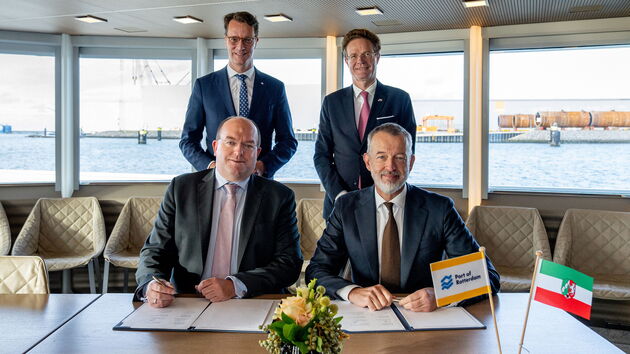
A central aim of the LoI is to develop sustainable transport corridors that accelerate the decarbonisation of industry.
Hendrik Wüst, Minister President of NRW, said: “Both ports will become central hubs for hydrogen and CO2 in the future, making them important partners on our path to climate-neutral industry. It is good news for North Rhine-Westphalia that both ports are taking their cooperation another step further. The close cooperation between Rotterdam and Duisburg strengthens the competitiveness of our economy – and especially the resilience of our supply chains.
“North Rhine-Westphalia remains a logistics hub for Europe, for energy supply, as well as for military mobility in mutual defence. Their cooperation signals confidence: by modernising infrastructure and deepening partnerships, we secure the future viability of our continent – in terms of economy, ecology as well as security policy.”
A key new focus of the collaboration is the export of CO2, critical for ‘hard to abate’ industries.
Decarbonising these sectors via carbon capture, utilisation and storage (CCUS) requires robust ports and high-performance transport chains.
Duisburg and Rotterdam are laying the groundwork for cross-border CCU/CCS initiatives, enabling targeted capture, storage, and utilisation of carbon dioxide.
The agreement also strengthens the Rhine corridor as a sustainable, cross-border logistics hub.
Markus Bangen, CEO of duisport, stated: “We face great challenges which we can overcome much more quickly, efficiently and intelligently together. It is crucial for us to bundle our expertise and develop collective cross-border solutions, especially in sustainable logistics and the sectors surrounding the energy transition. Logistics is a team sport – and the port of Rotterdam is our ideal partner.”
Boudewijn Siemons, CEO of the Port of Rotterdam Authority, added: “13 per cent of Europe’s energy demand is imported via Rotterdam. This is still primarily fossil fuels, but our long-term aim is to become Europe’s port for renewable energy imports.
“Inland shipping – and thus our cooperation with duisport – is especially important in the onward transport of these energy sources. As such, the waterway needs a strong lobby, and we are delighted that Minister President Wüst is setting a clear signal with his visit to Rotterdam.”
The two ports previously signed a LoI in 2022 covering cooperation in rail and inland land development, digitalisation, and the energy transition.
WeChat scan code

support hotline

mobile phone
Copyright © 2025 All Rights Reserved. Add:No. 8-1, Xigan Road, Xinwu District, Wuxi City 苏ICP备2025225786号 XML